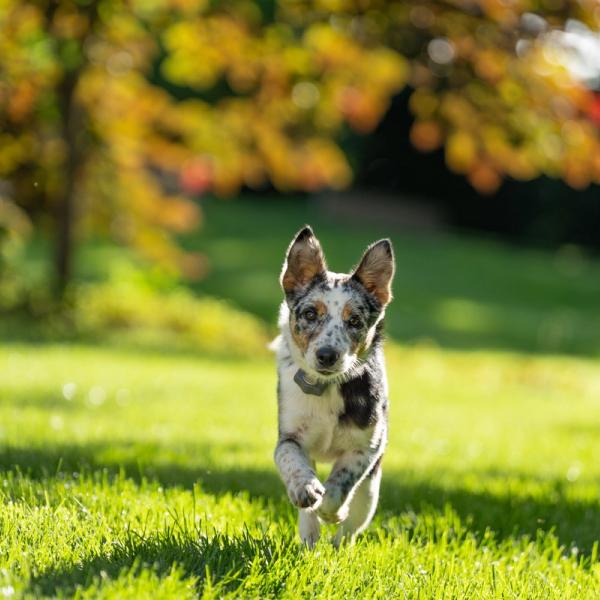


How to Stop Puppy Biting: Expert Training Tips
Is your puppy biting? Learn why puppies mouth, how to teach bite inhibition, and expert tips to train a puppy not to bite hands.
Ashley Donegan
Published 1/28/2026
Updated 8/5/2026
Choose your location
To make sure you're seeing the correct availability and pricing for products and services, please choose your location:
Please select your local dealer
So that we can provide you with accurate information and subscription options for your area.
Is your puppy biting? Learn why puppies mouth, how to teach bite inhibition, and expert tips to train a puppy not to bite hands.
Ashley Donegan
Published 1/28/2026
Updated 8/5/2026
You finally got the puppy of your dreams and pictured cuddles, soft fur, and gentle moments. But right now, you might be walking around your living room with a playful puppy tugging at your pant leg, while your hands feel the effects of those sharp baby teeth.
If you are wondering how to stop puppy biting, take a deep breath. This is a natural part of your puppy's development.
Learning how to train your puppy not to bite is a top priority for new owners. Whether you are trying to stop a puppy from biting hands during play or items in your home, understanding the why behind the behavior is the first step.
This guide will walk you through this "mouthing" phase and help you teach your puppy how to interact safely and gently.
Before we address the behavior, it is helpful to understand why your puppy uses their mouth so frequently. They aren't trying to be difficult; they are learning.
Puppies don’t have hands, so to learn about the world – texture, taste, etc.– they put everything in their mouths. That curiosity, combined with the discomfort of the teething stage, makes chewing a physical necessity.
If you have an 8-week-old biting puppy, this behavior usually peaks by 16 weeks. It is a developmental phase where they are learning boundaries and testing their environment. As their owner and guide, your role is to show them appropriate ways to interact. At Invisible Fence® Brand, we know that understanding your pet’s perspective is the key to successful training and a stronger relationship.
Not all mouthing is the same. Your dog's natural instincts play a role here:
Knowing the general biological schedule helps you understand your puppy's needs.
Keep in mind! This schedule can vary – each dog develops differently. Smaller breeds may develop later while larger breeds may develop earlier.
You’re not the only one walking around with bandages and bite marks. We analyzed the top Reddit communities like r/puppy101 and r/dogtraining, and found that mouthing is the number one challenge new puppy owners face, especially during the 8-to-16-week stage.
Here’s what real dog owners are saying:
What’s helping them most:
Redditors agree, it’s not about having a perfect puppy. It’s about setting them up for success, one gentle redirect at a time.
The goal isn't just to stop the behavior today, but to teach them bite inhibition as a regular habit. This is the vital lesson of learning to control the force of their jaws.
Puppy biting isn’t something we want to shut down- it’s something we want to shape. Redirection isn’t a shortcut; it’s how puppies learn appropriate items to interact with. Through that we can teach one of the most important life skills they’ll ever develop: bite inhibition. The goal isn’t simply to stop mouthing today, but to teach them how to control the force of their jaws for a lifetime. A puppy who learns a ‘soft mouth’ through guided play, appropriate outlets, and consistent redirection grows into a far safer, more reliable adult dog than one who was scolded into silence. We’re not just preventing biting, we’re teaching them how to bite gently and think clearly.
Ashley Donegan
Invisible Fence® Brand Professional Trainer
A golden rule of puppy raising is to have an appropriate item ready to bite before you interact with your dog.
Before they reach for your hand, redirect the biting to a toy instead. If they are teething, offer a frozen washcloth or a rubber chew toy to soothe their gums. Having access to appropriate toys in every room ensures you can always guide your puppy to the right choice.
Puzzle toys are one of the easiest ways to prevent inappropriate play nipping and teething. Try feeding meals out of puzzle toys until your puppy can show maturity around chewing and play biting. This creates mental stimulation that will occupy your pup multiple times a day and make them want to take a good nap!
When they wake up, they will need to go to the bathroom, and will most likely have a burst of energy, where you can be ready to offer another toy for them to redirect their mouthiness. This sequence repeats, creating a schedule that prevents inappropriate chewing and reinforces other training.
A mouthing puppy is often an overtired puppy.
When puppies get exhausted, they often become overstimulated rather than falling asleep. If your puppy has been awake for more than an hour and becomes difficult to redirect, they likely need a nap. Using crate training for a biting puppy is essential for their well-being.
If feedback and redirection aren't working, your puppy may need a moment to settle down. This isn't a punishment; it is a "Calm Reset."
Step away for a moment. You can step over a baby gate or simply stand up and ignore the behavior for 10–20 seconds. A brief pause in interaction teaches a simple lesson: "Gentle play keeps my human here; rough play stops the fun."
If you have children in the house, managing interactions with your puppy is key. Children often move quickly and make high-pitched noises, which can encourage excited play.
Teach children to "Be a Tree" if your puppy gets too excited:
When the child becomes calm and still, your puppy will usually lose interest and move on.
While most puppy mouthing is normal, there are times when professional guidance is recommended. Many owners ask, "Is my puppy aggressive or just biting?"
You should consider seeking expert advice if:
If puppy biting won’t stop and feels difficult to manage, contacting a certified professional trainer is the best step. At Invisible Fence® Brand, we believe in proactive training and ongoing support to help create a lifetime of safety, confidence, and freedom for pets and their families..
Mouthing is a phase, and with the right guidance, it will pass. Consistency is key. If everyone in the household follows the rules above, i.e., redirecting, rewarding calm behavior, and ensuring proper rest, your puppy will learn much faster.
Hang in there. With time and training, your puppy will learn to be the gentle companion you know they can be.