
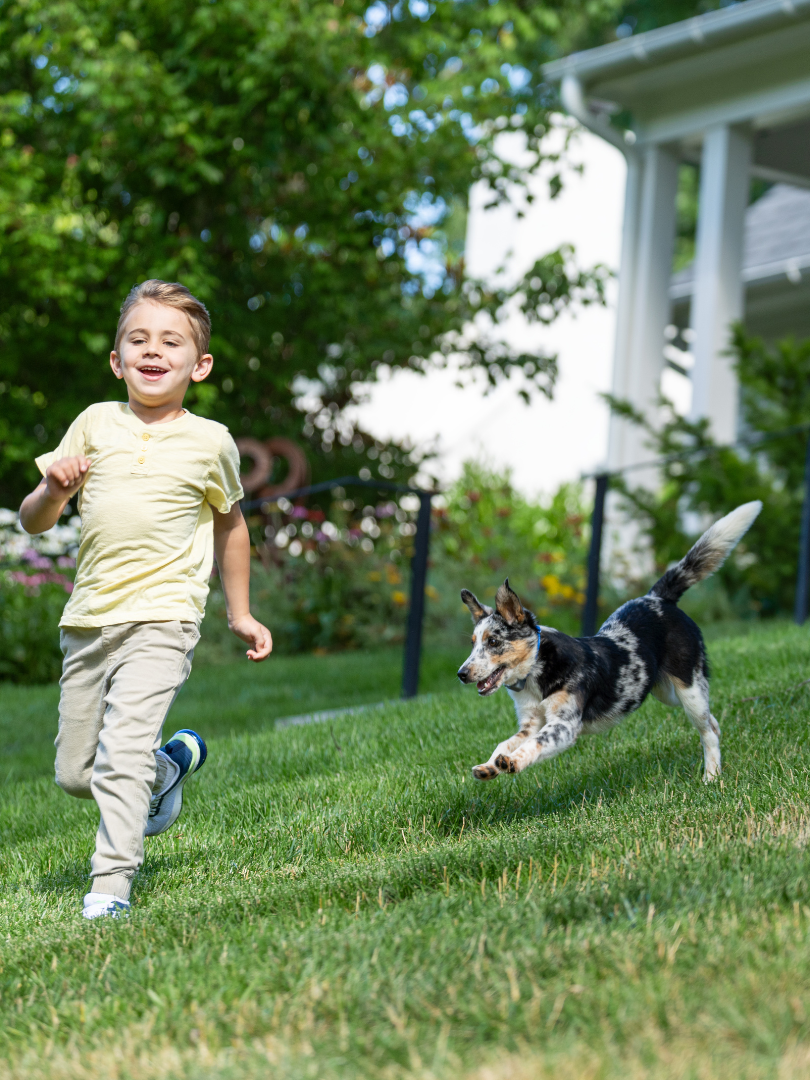


How Kids Can Help Train a Puppy Safely and Effectively
Teach kids how to help train a puppy with safe, fun activities that build good manners, confidence, and stronger family bonds.
Invisible Fence Brand
Published 12/13/2024
Updated 10/22/2026
Choose your location
To make sure you're seeing the correct availability and pricing for products and services, please choose your location:
Please select your local dealer
So that we can provide you with accurate information and subscription options for your area.
Teach kids how to help train a puppy with safe, fun activities that build good manners, confidence, and stronger family bonds.
Invisible Fence Brand
Published 12/13/2024
Updated 10/22/2026
Bringing home a puppy is exciting for the whole family, and training is one of the best ways to help your new companion grow into a well-mannered, confident dog. While adults should take the lead in establishing rules and routines, children can play an important role in training, too. In fact, when everyone in the household participates consistently, puppies learn faster and are less likely to become confused about what's expected of them.
The key is choosing age-appropriate activities, keeping training sessions fun, and always supervising interactions between children and dogs. Here are some simple, rewarding ways kids can safely help train a puppy while building a stronger bond along the way.
Training isn't just about teaching commands. It's about helping a puppy learn how to live successfully with your family. When children participate in training:
Our trainers often find that consistency is one of the biggest factors in successful puppy training. When everyone uses the same commands, rewards, and expectations, puppies learn more quickly and retain those lessons longer.
Before jumping into training activities, make sure children understand these important safety guidelines.
Even the gentlest puppy can become overly excited during play. Young children and dogs should never be left together unsupervised. Adults should be present to guide both the child and the puppy during training sessions.
Puppies have short attention spans. Aim for training sessions that last between 5 and 10 minutes. Several short sessions throughout the day are often more effective than one long session.
Reward behaviors you want to see with treats, praise, toys, or affection. Avoid punishment-based methods that can create confusion or fear.
Children should avoid chasing, yelling, or roughhousing with a puppy during training. Calm, consistent interactions help puppies focus and learn.
Not every training exercise is suitable for every child. Consider the following guidelines:
| Child's Age | Recommended Activities |
|---|---|
| 5-7 Years | |
| 5-7 Years | Sit, touch, treat rewards |
| 8-10 Years | |
| 8-10 Years | Stay, wait, recall games, obstacle courses |
| 11+ Years | |
| 11+ Years | Leash manners, trick training, advanced obedience practice |
Every child develops differently, so adult supervision and guidance remain essential regardless of age.
Avoiding these common mistakes can help training progress more smoothly:
Saying "Sit, sit, sit, sit!" teaches the puppy they don't need to respond the first time. Encourage children to give the command once and then help guide the puppy toward success.
Petting or talking to a puppy that is jumping, barking, or demanding attention can unintentionally reinforce those behaviors.
Consistency matters. Everyone in the household should use the same cue words, such as:
Using multiple words for the same behavior can slow learning.
An overly excited puppy may have difficulty focusing. Choose times when your puppy is calm, rested, and ready to learn.
While family training can accomplish a great deal, professional guidance can help address challenges more quickly and effectively.
Consider working with a trainer if your puppy is:
A professional trainer can help ensure everyone in the family is using the same techniques and building positive habits from the start.
If you'd like personalized guidance, Invisible Fence® Brand trainers are available in many areas for Manners Obedience Training Lessons to help your puppy develop the skills needed for a happy, well-behaved life.
Training a puppy is one of the most rewarding experiences a family can share. By involving children in age-appropriate training activities, you're not only helping your puppy learn important life skills, you're also teaching responsibility, patience, and compassion.
Most importantly, remember that consistency is key. When every member of the family follows the same approach, your puppy is more likely to develop the good manners and reliable behaviors that will last a lifetime.
Looking for more support during those early puppy months? Explore our puppy training resources or connect with your local Invisible Fence® Brand trainer for personalized guidance tailored to your family's needs.